
In the competitive online marketplace, simply bringing visitors to a website is not enough. Businesses also need to connect with people who have a real interest in their products or services. Lead Generation focuses on attracting these potential customers and encouraging them to take a meaningful step, such as submitting a form, requesting a quotation, asking for details, subscribing to an offer, or contacting the business directly.
A lead is a person or organization that has interacted with a business and shown some level of interest in its offering. For instance, a visitor who provides their name, email address, or phone number in exchange for information has taken the first step toward becoming a potential customer.
An effective Lead Generation approach allows businesses to reach a more relevant audience and create opportunities for future conversions. Rather than spending marketing resources on people who may have no interest, businesses can focus on prospects who are more likely to require their products or services.
There are many ways to generate leads online. Businesses can use search engines, social media platforms, websites, landing pages, paid advertising, email campaigns, and valuable content to attract potential customers. When these channels work together, they can turn online attention into genuine enquiries and business opportunities.
In this guide, you will learn how Lead Generation works, why it matters for business growth, which strategies can attract better prospects, what common mistakes businesses should avoid, and how to track the performance of lead generation campaigns.
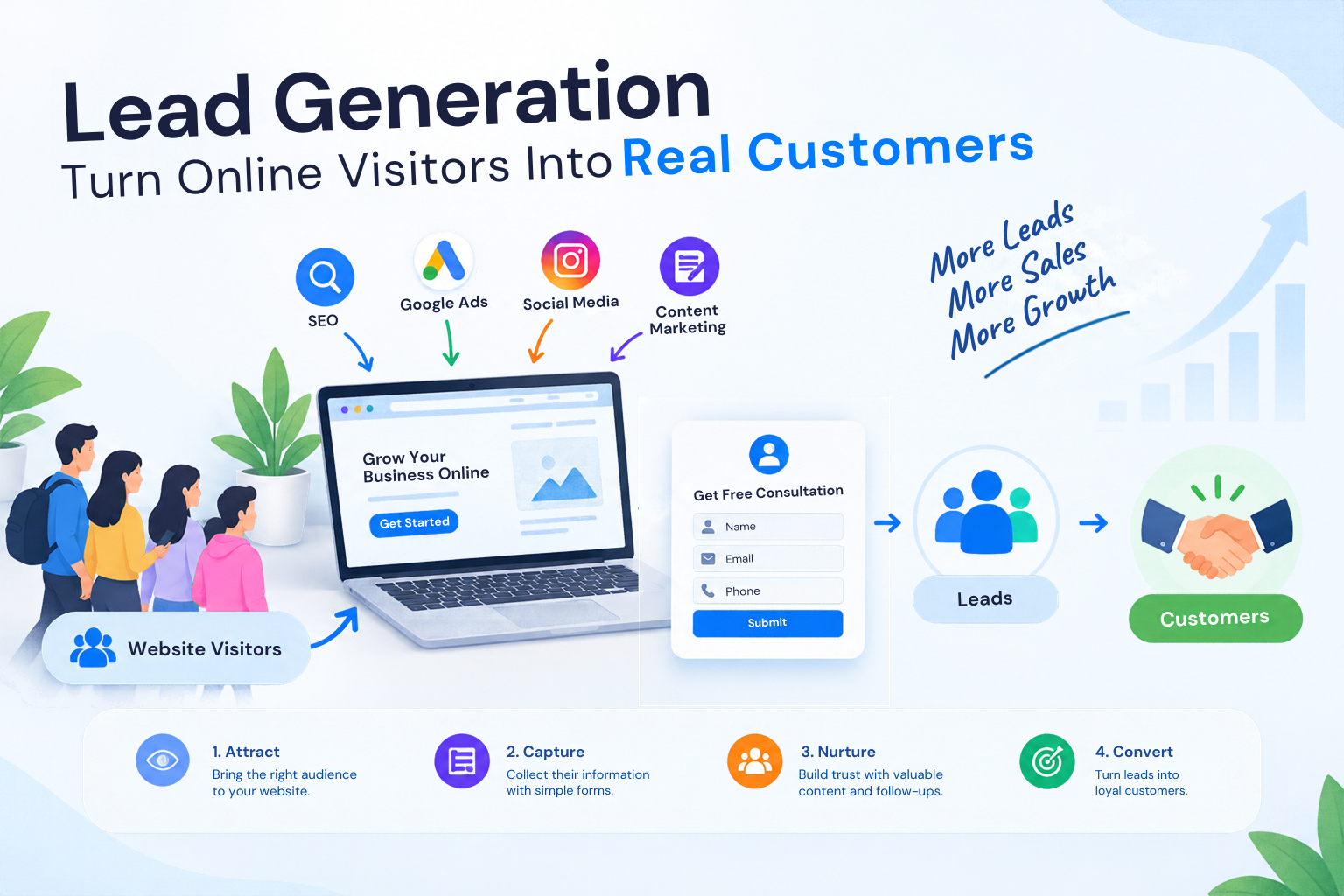
A lead is a person or business that has shown interest in a product or service. They may have discovered a business through Google, social media, an advertisement, a website, or another online channel.
For example, imagine a person searches online for website development services. They visit a company’s website, check the services, and fill out a form asking for a price or more information. This person has shown clear interest and can be considered a potential lead.
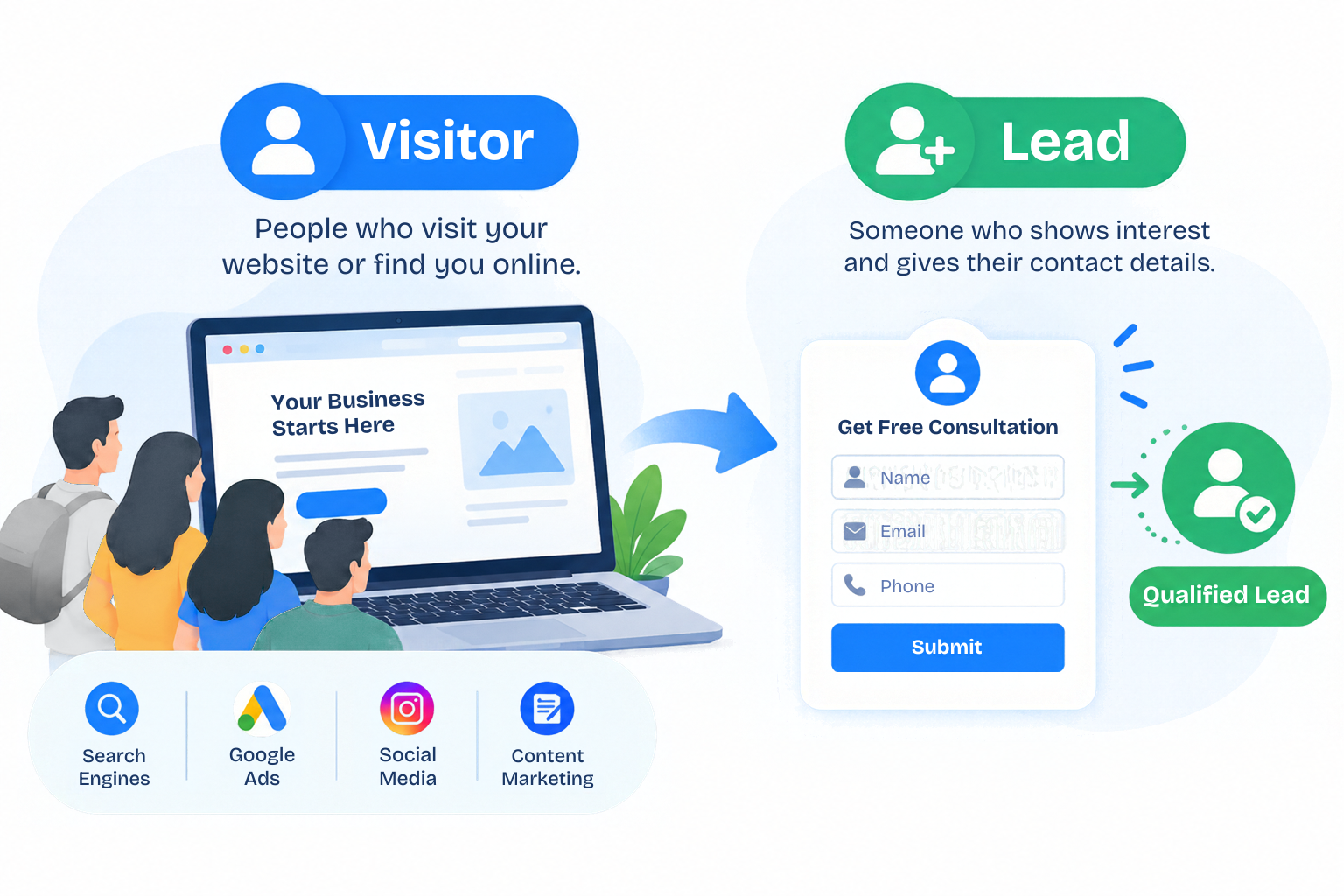
Not every website visitor is automatically a lead. A visitor generally becomes a lead when they take an action that shows interest and provides a way for the business to contact them.
Common lead actions include:
Filling out a contact form
Requesting a quotation
Calling the business
Sending a WhatsApp or online inquiry
Signing up for an email newsletter
Downloading a useful guide or resource
Booking a consultation or demo
Some leads are more valuable than others. A qualified lead is a potential customer who matches the business's target audience and has a genuine interest in its product or service.
For example, a company selling digital marketing services may receive inquiries from many people. A business owner who is actively looking for SEO or advertising services may be more relevant than someone who is only browsing information.
Identifying relevant leads allows businesses to focus their time and marketing efforts on people who have a stronger possibility of becoming customers.
Every business needs a steady flow of potential customers to grow. Having a website or social media page is useful, but simply getting visitors does not always result in sales. Businesses need a clear process to attract interested people and turn their interest into real opportunities.
Lead Generation helps businesses build this process. It allows companies to reach people who may need their products or services and encourage them to take the next step.
Lead generation helps businesses reach people who are interested in what they offer. Through search engines, social media, content, and online advertising, businesses can introduce their products or services to a relevant audience.
Every website visitor may not be ready to buy right away. By capturing their contact information and inquiries, businesses can maintain communication, share helpful content, and build trust until potential customers are ready to take the next step.
A good strategy focuses on the target audience instead of trying to reach everyone. Businesses can use customer interests, needs, location, and online behavior to create more relevant marketing campaigns.
Lead generation is not only about getting contact information. It also creates an opportunity to communicate with potential customers, answer their questions, understand their needs, and build trust over time.
Digital lead generation can be tracked using different metrics, such as leads received, conversion rate, cost per lead, and website activity. These insights help businesses understand which marketing activities are producing useful results.
Overall, an effective lead generation process can connect businesses with potential customers, create new sales opportunities, and support consistent digital growth.
Lead Generation works by guiding people from their first interaction with a business toward taking a useful action. The process can be different for every business, but the basic journey usually follows a simple path.
The first step is to reach people who may be interested in your product or service. Businesses can use SEO, social media, Google Ads, content marketing, and other digital channels to bring relevant visitors to their website.
Once people reach your website or social media page, the next step is to give them useful information. Helpful blogs, service details, videos, offers, guides, and other content can answer questions and encourage visitors to learn more.
After building interest, businesses need a simple way to collect information from potential customers. A contact form, consultation request, quotation form, newsletter signup, or inquiry button can be used for this purpose.
The form should ask only for information that is actually needed, such as name, email address, phone number, or business requirements.
Not every person who submits a form will become a customer. Businesses can review each inquiry and identify which leads are relevant to their products or services.
Factors such as customer needs, budget, location, requirements, and purchase timeline can help businesses understand lead quality.
Quick and helpful follow-up is an important part of the process. Businesses can contact potential customers through phone calls, email, WhatsApp, or other suitable communication channels.
The goal is to understand the customer's needs and provide the right information rather than simply sending repeated promotional messages.
The final stage is conversion. When a potential customer is ready and the business can meet their needs, the lead may become a paying customer.
Simple Lead Generation Process:
Attract → Engage → Capture → Qualify → Follow Up → Convert
By creating a clear process for each stage, businesses can manage potential customers more effectively and create better opportunities for growth.
Reach your ideal audience through smart and effective digital marketing strategies. The right strategy depends on the target audience, industry, budget, and business goals. Combining multiple channels can help create a consistent flow of relevant inquiries.
Your website is often the first place where potential customers learn about your business. A professional website should clearly explain your services, benefits, contact information, and next steps.
Add simple call-to-action buttons such as Get a Quote, Contact Us, Book a Consultation, or Request More Information. These buttons make it easier for interested visitors to take action.
A landing page is designed around a specific offer, service, or campaign. Instead of sending visitors to a general homepage, businesses can direct them to a focused page with relevant information and a clear action.
A good landing page should have a strong headline, useful content, trust-building information, and a simple inquiry form.
SEO helps businesses strengthen their online presence and appear more prominently in search results. By creating valuable, relevant, and optimized content, businesses can attract the right audience, increase website traffic, and connect with potential customers actively searching for their products or services.
Blog posts, service pages, local SEO, keyword optimization, and helpful resources can support organic traffic and potential customer discovery.
Social media platforms help businesses expand their reach, engage with their target audience, and build strong brand awareness online. Businesses can share educational posts, short videos, customer-focused content, offers, case studies, and service information.
Platforms such as Instagram, Facebook, and LinkedIn can be used according to the audience and type of business.
Paid advertising can help businesses reach specific audiences based on factors such as search intent, interests, location, or other available targeting options.
Search and social advertising campaigns can direct interested users to relevant landing pages where they can make an inquiry or submit their details.
Valuable content can attract and educate people who are searching for solutions. Businesses can create engaging blogs, helpful guides, informative videos, practical checklists, case studies, and other resources to answer questions and build trust with their audience.
When content provides genuine value, it can build trust and encourage interested visitors to take the next step.
Email marketing can help businesses stay connected with people who have already shown interest. Businesses can send useful information, service updates, educational content, or relevant offers based on the customer's interests.
Consistent and helpful communication can keep the business in the customer's mind while they consider their options.
A useful free resource can encourage visitors to share their contact details. Examples include a free consultation, downloadable guide, checklist, product demo, estimate, or business assessment.
The offer should be relevant to the audience and provide a clear reason for taking action.
A combination of these strategies can help businesses attract the right audience, collect meaningful inquiries, and create a structured path from website visitor to potential customer.
A Lead Generation Funnel is a simple way to understand how a person moves from discovering a business to becoming a potential customer. Not every visitor is ready to buy immediately, so businesses need to guide people through different stages.
At this stage, people first discover your business. They may find your website through Google, social media, online advertisements, videos, or blog content.
The main goal is to introduce your business and make people aware of your products or services.
After discovering the business, some visitors may want to learn more. They might read your blog, explore your services, check your social media pages, or visit different sections of your website.
Useful and relevant content can help maintain their interest.
At this stage, potential customers are comparing their options and trying to decide which solution fits their needs. They may check pricing, reviews, features, previous work, or service details.
Clear information and trust-building content can help them make an informed decision.
When an interested visitor takes an action such as submitting a form, requesting a quotation, booking a consultation, or making an inquiry, they can become a lead.
This gives the business an opportunity to communicate directly with the potential customer.
The final stage is conversion. After understanding the customer's requirements and providing the appropriate solution, a lead may decide to purchase a product or service.
Simple Lead Generation Funnel
Awareness → Interest → Consideration → Lead → Conversion
Understanding this funnel helps businesses identify where potential customers are entering, where they may be losing interest, and which parts of the customer journey can be improved.
Getting more inquiries does not always mean getting better business opportunities. What matters is attracting people who have a genuine interest in your products or services. A well-planned Lead Generation strategy helps businesses reach the right audience and turn interested visitors into valuable prospects.
Before starting any marketing activity, understand who your ideal customers are. Look at factors such as their needs, challenges, location, interests, spending capacity, and purchasing habits.
Knowing your audience makes it easier to create content and marketing messages that connect with the people most likely to need your products or services.
People are more likely to share their contact details when they receive something useful in return. Businesses can provide offers such as a free consultation, price estimate, product demo, helpful guide, checklist, or informative resource.
Choose an offer that provides genuine value and addresses a specific need or problem faced by your potential customers.
Visitors should easily understand what action they need to take next. Clear calls to action can guide them toward contacting your business or requesting more information.
Use straightforward phrases like Get Started, Request a Quote, Talk to Us, Book a Demo, or Contact Us. Add CTAs naturally throughout your website and landing pages where they are relevant.
A complicated form with too many questions can discourage visitors from completing it. Keep your lead forms short and collect only the information required for the next step.
For example, you may begin with basic details such as the visitor's name, phone number, email address, and service requirement. Additional information can be collected later when needed.
A dedicated landing page should clearly match the advertisement, keyword, or content that brought the visitor to it. Explain the main benefit, provide important information, and make the next action easy to find.
Keep the landing page clean and focused by removing anything that could distract visitors. A simple layout makes the offer easier to understand and helps users feel more confident about taking the desired action.
Regularly review your marketing performance to understand which channels and campaigns are producing useful leads. Important measurements can include conversion rate, cost per lead, total inquiries, and qualified lead volume.
These insights can help businesses identify what is working and make informed improvements to their website, advertising, content, and marketing campaigns.
Generating a lead is only the beginning. When someone submits an inquiry, responding promptly can help maintain their interest.
Understand what the prospect needs, answer their questions, share relevant information, and continue communication when appropriate. A structured follow-up process can help move potential customers closer to making a decision.
By understanding the target audience, offering useful resources, creating focused landing pages, using clear CTAs, and following up consistently, businesses can build a stronger Lead Generation strategy and attract more relevant potential customers.
A successful Lead Generation process requires continuous testing, monitoring, and improvement. Even when businesses invest in marketing, small mistakes can reduce the quality of their results. Identifying these common issues can help create a smoother experience for potential customers and improve overall lead quality.
Marketing efforts may not deliver useful results when they are aimed at people who are unlikely to need the product or service. Reaching a large audience is not always enough if the audience is not relevant.
Clearly define your ideal customer before planning your campaigns and promotional activities.
Asking visitors to provide too many details can make the inquiry process feel difficult. If a form takes too much time to complete, some potential customers may leave without submitting it.
Keep your forms short and request only the essential information required to begin the conversation.
Visitors may hesitate to take action when a website does not clearly explain what they should do next. A direct CTA can make the process easier and more understandable.
Use action-oriented buttons such as Contact Us, Request a Quote, Get Started, or Schedule a Call based on your business goal.
Sending visitors to a page that does not match the advertisement or marketing message can create confusion. The landing page should provide information that is directly related to what attracted the visitor.
Keep the page relevant, easy to navigate, and focused on one main offer or objective.
Collecting contact details does not complete the process. When businesses take too long to respond, interested prospects may move on or choose another option.
Set up a clear follow-up system so that new inquiries can be reviewed, answered, and managed properly.
Without proper measurement, it becomes difficult to know which campaigns are generating valuable results. Simply counting the total number of leads may not provide the complete picture.
Track metrics such as conversion rate, cost per lead, total leads, and qualified inquiries to understand campaign performance. Reviewing these numbers regularly can help businesses adjust their strategies and improve future marketing efforts.
Launching a marketing campaign is only the first step. Businesses should also check whether their efforts are bringing the right people and producing meaningful results. Tracking important Lead Generation metrics makes it easier to understand campaign performance and identify areas that need improvement.
This metric represents the overall number of people who show interest by completing an action, such as filling out a form, sending an inquiry, or requesting additional details.
A growing number of leads can show audience interest, but businesses should also examine whether those leads are relevant and valuable.
Conversion rate shows the percentage of website visitors who complete a specific goal, such as submitting a form or contacting the business.
For example, if 200 visitors reach a landing page and 10 submit an inquiry, the conversion rate would be 5%.
Cost per lead indicates the average amount spent to generate one lead through a marketing campaign.
Formula:
Total Advertising Cost ÷ Number of Leads Generated = Cost Per Lead
Comparing this figure across different campaigns can help businesses understand how efficiently their marketing budget is being used.
Not every inquiry will become a potential customer. Qualified leads are prospects who fit the business's target audience and have a genuine interest or requirement.
Monitoring qualified leads gives businesses a better understanding of the actual value being generated rather than focusing only on the total number of inquiries.
Click-through rate (CTR) shows the percentage of people who click on an advertisement, link, or other clickable element after seeing it.
A relevant message, attractive offer, and straightforward call to action can help encourage users to visit the website or landing page.
This metric shows how many generated leads eventually turn into paying customers. It helps businesses evaluate the quality of their leads and understand what happens after an inquiry is received.
By reviewing these metrics regularly, businesses can discover which marketing channels are producing meaningful results, improve campaign performance, control spending, and make more informed decisions about their Lead Generation activities.
A well-planned Lead Generation strategy can help businesses connect with potential customers and create more opportunities throughout the buying journey. Instead of depending only on random inquiries, businesses can build a more organized process for attracting and engaging interested prospects.
Effective lead generation helps businesses consistently attract people who may need their products or services. These prospects can become new conversations, inquiries, and potential sales opportunities.
Online marketing allows businesses to focus their efforts on specific groups based on factors such as interests, needs, location, and online behavior. This can make marketing messages more relevant to the intended audience.
When prospects provide their contact details or request information, businesses can learn more about their needs. Sales teams can then provide suitable information and guide prospects through the decision-making process.
Lead generation can help businesses stay connected with interested prospects through useful content, personalized communication, and timely responses. These interactions can support stronger relationships over time.
Digital lead generation activities can be measured using data such as the number of leads, conversion rate, cost per lead, and customer conversions. These measurements help businesses understand how their campaigns are performing.
Regularly attracting and nurturing prospects can help businesses maintain a steady flow of potential customers. A consistent process can contribute to business development and support long-term digital growth.
The main goal of Lead Generation is not simply to increase the number of inquiries. Businesses should focus on reaching relevant prospects, offering useful information, and creating a smooth experience that encourages potential customers to take the next step.
Lead Generation refers to the process of attracting potential customers and encouraging them to show interest in a business. This can happen through actions such as filling out a contact form, requesting pricing, booking a consultation, or sending an inquiry.
It gives businesses a way to find interested prospects, create new sales opportunities, stay connected with potential customers, and develop a steady flow of inquiries.
A typical process starts with reaching the right audience, creating interest, collecting contact details, identifying suitable prospects, following up, and guiding them toward the next stage of the buying journey.
A qualified lead is a prospect who fits the business's customer profile and shows a relevant need or genuine interest in the offered product or service.
Businesses can use contact forms, inquiry buttons, quote requests, booking options, dedicated landing pages, valuable resources, and special offers to encourage visitors to share their details.
Yes. Social platforms can help businesses reach potential customers, publish useful content, promote their offerings, encourage interactions, and send interested users to a website or inquiry page.
SEO can bring visitors who are already searching for related products, services, or solutions. Well-optimized pages and useful search-focused content can help attract relevant visitors from organic search results.
Google Ads can show paid advertisements to users searching for particular products or services. Businesses can send those users to a relevant landing page where they can submit an inquiry, request information, or complete another desired action.
Start by defining the ideal customer and creating messages that match their needs. Relevant landing pages, well-planned forms, targeted campaigns, and performance tracking can also help businesses identify and attract more suitable prospects.
The timeframe varies from one business to another. Factors such as industry, audience, budget, offer, marketing channel, website quality, and consistency can affect results. Some campaigns may receive inquiries quickly, while building a reliable source of quality leads generally requires ongoing effort and optimization.