

Technology is changing the way people work, communicate, create content, and manage businesses. Among the biggest changes, AI Tools have become an important part of the modern digital world. From generating ideas and writing content to analyzing information and automating repetitive tasks, artificial intelligence is helping people complete many activities faster and more efficiently.
In 2026, AI is no longer limited to large technology companies or advanced professionals. Students, creators, marketers, entrepreneurs, small businesses, and organizations can use AI-powered solutions for everyday tasks. The right tool can save valuable time, improve productivity, support creativity, and help businesses make better use of their digital resources.
However, choosing an AI solution simply because it is popular may not always produce the best results. Different tools are designed for different purposes, and understanding their features, benefits, limitations, and practical applications is essential.
In this guide, we will explore how AI Tools are changing modern work, the major categories available, how businesses can use them, and what to consider when selecting the right solution for specific goals.
AI Tools for Smarter Business Growth
AI Tools are software applications that use artificial intelligence technologies to perform tasks that normally require human thinking, analysis, creativity, or decision-making. Depending on their purpose, these tools can understand text, generate content, recognize patterns, analyze data, create images, summarize information, assist with coding, or automate repetitive activities.
Unlike traditional software that usually follows a fixed set of programmed instructions, AI-powered applications can process information and produce results based on the input they receive. For example, a user can provide a simple instruction, often called a prompt, and an AI system can generate a response based on the context and information available to it.
What Are AI Tools and How Do They Work?
Most modern AI applications rely on technologies such as machine learning, natural language processing, computer vision, and generative AI. These technologies allow systems to identify patterns in information and produce useful outputs.
For example, a content creator can provide a topic and ask an AI writing tool to suggest ideas or create a first draft. Similarly, a marketer can use AI to analyze campaign information, generate advertising ideas, or organize customer data.
The quality of the result often depends on the quality of the input. Clear instructions, relevant context, and human review can help users get more useful and accurate results.
How Do AI Tools Work?
Traditional software generally performs predefined functions. AI-powered software can offer more flexible and intelligent assistance by interpreting user requests and adapting its output to different situations.
This does not mean AI should replace human judgment. Instead, it can work as a digital assistant that helps people reduce repetitive work, explore ideas, and complete tasks more efficiently. The most effective approach is often a combination of AI capabilities and human experience.
AI Tools vs. Traditional Software
The digital world is moving faster than ever, and businesses are expected to create more, respond quickly, and deliver better experiences with limited time and resources. This is one of the major reasons AI Tools are becoming increasingly valuable in 2026. They can support everyday workflows while allowing people to focus more on planning, creativity, and decision-making.
Faster and More Efficient Work
Many professionals spend a significant amount of time on repetitive activities such as drafting emails, organizing information, creating summaries, or preparing basic reports. AI can assist with these tasks and reduce the amount of manual effort required.
Better Productivity
AI-powered solutions can help users manage information, generate ideas, summarize lengthy material, and organize routine workflows. Instead of starting every task from scratch, professionals can use AI assistance to create a starting point and then improve the final result themselves.
Support for Creativity
AI is also becoming a useful creative partner. Writers can explore content ideas, designers can develop visual concepts, and marketers can brainstorm campaign directions. Rather than replacing creativity, these technologies can provide new starting points and help users experiment with different approaches.
Smarter Business Decisions
Businesses generate large amounts of information through websites, advertising campaigns, customer interactions, and sales activities. AI can help analyze patterns within this information and turn complex data into more understandable insights. Human expertise is still important for interpreting those insights and making final decisions.
Automation of Repetitive Tasks
Another important advantage is automation. Businesses can use AI-powered systems to assist with customer queries, workflow management, data processing, content preparation, and other repetitive activities. This can give teams more time to focus on tasks that require strategy and human interaction.
Growing Accessibility
AI technology is no longer restricted to companies with large technical teams. Many solutions are now designed for everyday users, making AI easier to adopt across industries and business sizes.
As AI continues to become part of common digital workflows, understanding how to use these technologies responsibly and effectively can become an important skill for professionals and businesses in 2026.
Why AI Tools Are Becoming Important in 2026
AI technology is not limited to one type of application. Different AI Tools are designed to solve different problems, from creating content and visuals to analyzing information and improving business workflows. Understanding these categories can make it easier to identify which type of solution is suitable for a particular task.
AI Tools for Content Creation
Content creation is one of the most common areas where artificial intelligence is being used. These tools can assist with blog ideas, social media posts, product descriptions, email drafts, scripts, and other forms of written content.
They can also help users rewrite sentences, summarize lengthy information, improve readability, and generate different content variations. However, the final content should be reviewed by a person to ensure that it matches the brand’s voice, provides accurate information, and offers genuine value to readers.
For businesses, AI-assisted content creation can make it easier to maintain a consistent publishing schedule without depending entirely on manual processes.
Different Types of AI Tools You Can Use
Visual content plays an important role in websites, social media, advertising, presentations, and branding. AI-powered design applications can help users create visual concepts, generate images, remove backgrounds, improve existing visuals, and develop creative layouts.
These solutions can be particularly useful for small businesses and creators who may not have a dedicated design team. Instead of replacing professional designers, they can speed up brainstorming and handle simple design tasks while professionals focus on more complex creative work.
AI Tools for Marketing
Digital marketing involves research, content planning, advertising, audience analysis, reporting, and continuous optimization. AI can assist marketers across several of these activities.
Marketing-focused AI solutions can help generate campaign ideas, analyze customer behavior, suggest content topics, organize information, and support advertising workflows. They can also help marketers identify patterns in performance data and make optimization decisions more efficiently.
The important point is that AI should support a marketing strategy rather than become the strategy itself. Human understanding of the audience, market, brand, and business objectives remains essential.
AI Tools for Productivity
Productivity-focused AI applications are designed to help people manage information and complete everyday work more efficiently. Common uses include summarizing documents, organizing notes, preparing meeting summaries, drafting emails, creating task lists, and assisting with research.
For professionals who regularly work with large amounts of information, these capabilities can reduce time spent on administrative activities. Students can also use them to organize study material, understand complex topics, and create structured notes.
The best results come when users treat AI as an assistant and verify important information before using the output.
AI Tools for Business Operations
Businesses can use AI in several operational areas, including customer support, sales assistance, data analysis, workflow automation, and internal communication.
For example, an AI-powered customer support system can help answer common questions, while more complex requests can be passed to human team members. AI can also assist sales teams by organizing customer information, preparing follow-up messages, or identifying useful patterns in business data.
These applications can help organizations improve efficiency while allowing employees to spend more time on tasks that require communication, judgment, and relationship building.
AI Tools for Developers
Software developers are also using AI to support different stages of development. AI coding assistants can help generate code suggestions, explain programming concepts, identify potential errors, create documentation, and assist with repetitive development tasks.
For beginners, these tools can make technical concepts easier to understand. Experienced developers can use them as productivity assistants when working on larger projects.
However, generated code should always be reviewed, tested, and understood before it is added to a production application. Human technical judgment remains essential for security, performance, reliability, and maintainability.
AI Tools for Data Analysis
Data can be difficult to understand when it is spread across large spreadsheets, databases, or reports. AI-powered data solutions can help users identify patterns, summarize information, generate insights, and support data-driven decision-making.
Businesses can use these capabilities to better understand sales performance, customer behavior, marketing results, and operational trends.
While AI can make analysis faster, users should still check the underlying data and understand how conclusions were reached. Accurate input and proper interpretation are necessary for reliable business decisions.
AI Tools for Graphic Design and Visual Creation
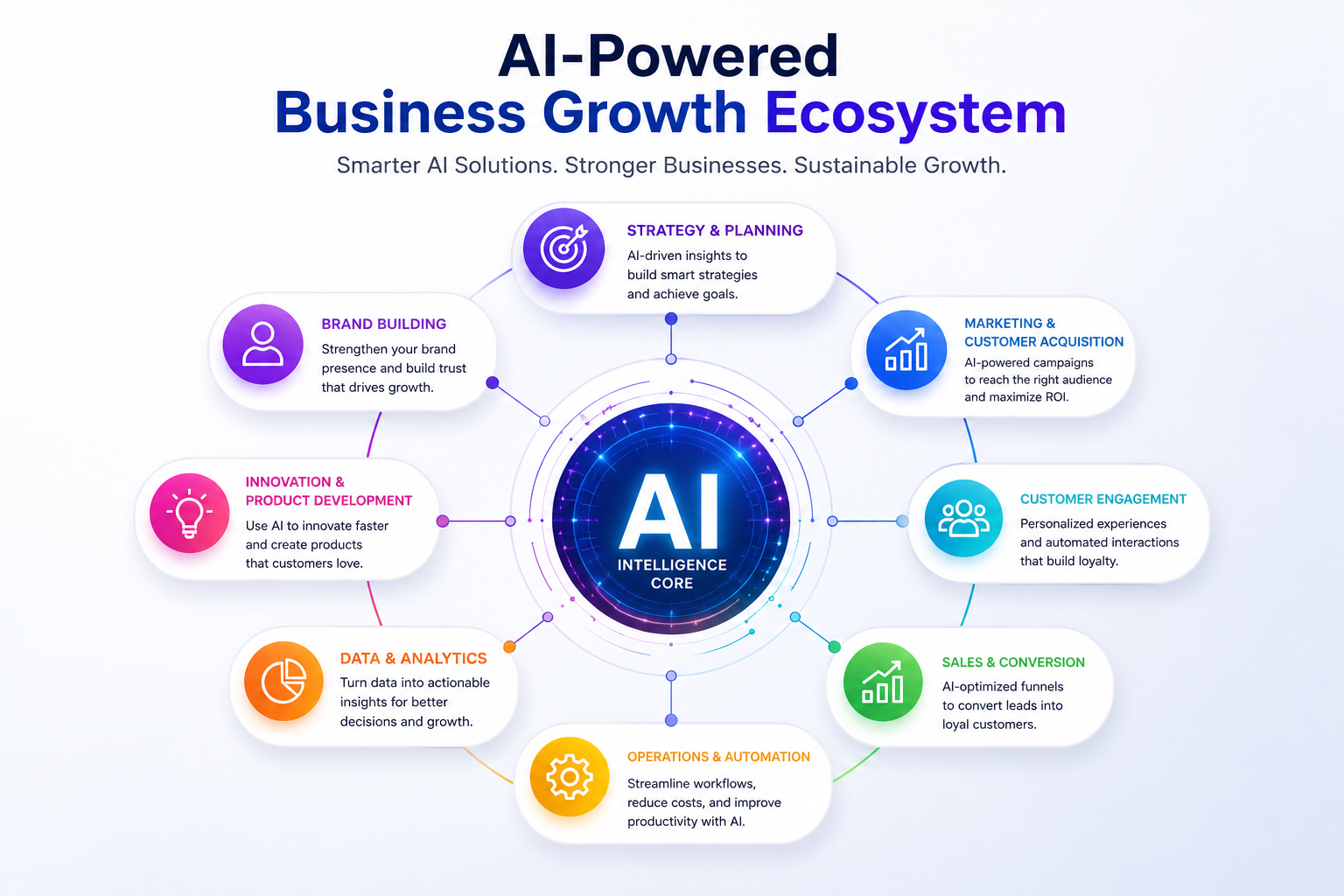
For modern businesses, growth is not only about attracting more customers. It also involves improving internal processes, responding to customers efficiently, understanding data, and creating better digital experiences. AI Tools can support many of these activities when they are selected according to a clear business objective.
Save Time on Repetitive Work
Businesses often spend hours completing routine activities such as drafting messages, organizing information, preparing summaries, and handling basic customer questions. AI can assist with many of these processes, allowing employees to spend more time on strategic and creative responsibilities.
Improve Marketing Efficiency
AI can support digital marketing teams with content ideas, audience research, campaign planning, performance analysis, and repetitive marketing tasks. This can help teams work more efficiently while maintaining a consistent marketing workflow.
Enhance Customer Experience
Fast and relevant communication can make a significant difference in customer satisfaction. AI-powered chat systems and support solutions can respond to common questions, provide basic information, and guide customers toward appropriate resources. Human support can then handle more complex or sensitive conversations.
Turn Business Data Into Useful Insights
Businesses collect information from websites, advertising platforms, sales systems, and customer interactions. AI can help organize and analyze this information, making it easier to identify trends and opportunities.
For example, a business may discover which products receive the most interest or which marketing activities generate stronger engagement. These insights can support better planning and decision-making.
Support Business Scalability
As a company grows, its workload often increases. AI-assisted automation can help businesses handle certain repetitive processes without increasing manual work at the same rate.
However, successful implementation requires more than simply adding AI to a workflow. Businesses should identify the right use cases, protect sensitive information, monitor results, and keep human oversight where it matters.
When used strategically, AI can become a valuable support system that improves efficiency while helping teams focus on long-term business growth.
How AI Tools Can Support Business Growth
With hundreds of AI-powered applications available today, choosing the right one can sometimes feel overwhelming. The most popular solution is not necessarily the best option for every user or business. Before selecting an AI Tool, it is important to understand the specific problem you want to solve.
Start With a Clear Goal
First, identify what you want the tool to accomplish. Are you looking for help with content creation, design, marketing, data analysis, customer support, productivity, or automation? A clear objective will make it easier to compare suitable options.
Check the Features
Once you know your goal, review the features offered by different solutions. Look for capabilities that directly support your workflow rather than choosing a tool simply because it has many features.
Consider Ease of Use
A powerful tool is only useful when your team can use it effectively. Check whether the interface is simple, whether it offers helpful documentation, and whether users can learn the platform without extensive technical knowledge.
Compare Pricing and Plans
Many AI applications provide free versions, trials, or different subscription levels. Compare pricing based on your actual usage and business requirements. A more expensive plan is not automatically better if you only need basic features.
Review Privacy and Security
Businesses should pay close attention to how an AI platform handles information. Before entering confidential business, customer, financial, or personal data, review the provider’s privacy and security policies.
Test Before Making a Long-Term Decision
If a free trial or demo is available, use it before committing to a paid plan. Test the tool with real-world tasks and evaluate the quality, speed, accuracy, and usefulness of its results.
The right AI solution should fit naturally into your existing workflow. Instead of collecting too many tools, businesses can often achieve better results by selecting a smaller number of reliable solutions that solve specific problems effectively.
How to Choose the Right AI Tool for Your Needs
Using AI effectively is not simply about finding a tool and accepting everything it produces. The quality of the final result depends on how the technology is used, reviewed, and combined with human knowledge. Following a few practical principles can help users get more value from AI Tools.
Give Clear and Specific Instructions
AI systems generally perform better when the user provides clear instructions and useful context. Instead of giving a vague request, explain the purpose, audience, preferred format, tone, and important details.
Always Review AI-Generated Output
AI-generated information can sometimes contain mistakes, outdated details, or misleading statements. Important content should be reviewed and fact-checked before it is published or used for business decisions.
Add Human Creativity
AI can generate ideas quickly, but human experience, creativity, and personal understanding remain valuable. Reviewing and improving AI-generated work can make the final result more original, relevant, and aligned with a brand’s identity.
Protect Sensitive Information
Users should be careful when sharing confidential business information, customer details, passwords, financial records, or other sensitive data with AI platforms. Understanding the tool’s privacy practices before using it for sensitive work is an important step.
Use AI as an Assistant
AI works best when it supports human capabilities rather than replacing human judgment completely. It can help with brainstorming, research, organization, and repetitive tasks while people remain responsible for important decisions.
Keep Learning as Technology Changes
AI technology is developing quickly, and new features and workflows continue to appear. Regularly learning about new capabilities can help professionals identify better ways to use AI in their daily work.
The goal should not be to use AI for every task. Instead, identify areas where it can genuinely save time, improve quality, or create better outcomes. A thoughtful approach can make AI a useful long-term part of a digital workflow.
Best Practices for Using AI Tools Effectively
The development of artificial intelligence is moving quickly, and the role of AI Tools is expected to expand across both professional and personal workflows. What once required separate software, technical knowledge, or significant manual effort can increasingly be supported through intelligent digital solutions.
More Personalized AI Experiences
Future AI applications are likely to become more personalized to individual users and businesses. Instead of providing the same type of assistance to everyone, systems can increasingly adapt to specific workflows, preferences, goals, and business requirements.
Greater Integration Across Digital Platforms
AI is also becoming part of everyday software rather than existing only as a separate application. Business platforms, marketing systems, productivity applications, design software, and customer service solutions can increasingly include AI-powered features within existing workflows.
Increased Business Automation
Businesses are likely to use AI for more complex workflows, from customer communication and content production to data analysis and operational processes. This could allow teams to reduce repetitive work and focus more heavily on strategy, creativity, and customer relationships.
Human and AI Collaboration
The future of AI is not necessarily about replacing every human task. A more practical direction is collaboration between people and intelligent systems. AI can handle repetitive or information-heavy activities, while humans provide creativity, emotional understanding, critical thinking, and final judgment.
As these technologies continue to develop, the most valuable skill may not simply be knowing which AI application to use. It will be understanding when, where, and how to use AI effectively. Businesses and professionals who combine technology with human expertise can create more efficient and adaptable digital workflows.
The Future of AI Tools
AI Tools are becoming an important part of the way people work, create, communicate, and manage digital activities in 2026. From content creation and design to marketing, productivity, business operations, development, and data analysis, AI can support a wide range of everyday tasks.
However, successful AI adoption is not about using the maximum number of tools. It is about identifying the right problems and choosing solutions that genuinely improve a workflow. Clear instructions, human review, data protection, and continuous learning are equally important when working with AI.
For businesses, the combination of AI technology and human expertise can create a more efficient approach to digital growth. AI can handle repetitive processes and assist with information-heavy tasks, while people continue to provide strategy, creativity, experience, and decision-making.
As AI continues to evolve, businesses that learn how to use it responsibly and strategically can be better prepared for an increasingly digital future.
Ready to explore smarter digital solutions for your business? Connect with Velixo Digital and discover how AI-powered strategies can support your online growth and digital marketing goals.
Final Thoughts on AI Tools
1. What Are AI Tools, and How Can They Benefit Businesses?
AI Tools are software applications that use artificial intelligence to help users complete tasks such as writing, research, design, data analysis, marketing, automation, and productivity. They are becoming important because they can save time, simplify repetitive work, and support better digital workflows.
2. How Can AI Tools Improve Productivity?
AI Tools can improve productivity by helping with repetitive and time-consuming activities. Users can create summaries, organize information, generate ideas, draft emails, prepare documents, and manage routine tasks more efficiently. This allows professionals to spend more time on important strategic and creative work.
3. Can Small Businesses Benefit From AI Tools?
Yes, small businesses can use AI Tools for content creation, customer support, marketing, data analysis, research, and workflow automation. These solutions can help smaller teams manage certain tasks more efficiently without requiring a large technical team.
4. Which Types of AI Tools Are Most Useful?
The most useful type depends on the user’s goal. Common categories include AI writing tools, image generation tools, marketing solutions, productivity assistants, data analysis applications, coding assistants, customer support systems, and business automation platforms.
5. Can AI Tools Help With Digital Marketing?
Yes. AI can support digital marketing activities such as content ideas, audience research, advertising copy, campaign analysis, keyword research, social media planning, and reporting. However, marketers should combine AI assistance with their own strategy and understanding of the target audience.
6. Are AI Tools Useful for Content Creation?
AI Tools can assist with blog ideas, social media captions, product descriptions, email drafts, scripts, summaries, and content outlines. Human editing is still important to make the final content accurate, original, useful, and aligned with the brand’s voice.
7. Can AI Tools Replace Human Employees?
AI can automate certain repetitive activities, but it does not completely replace human skills. Creativity, critical thinking, communication, emotional understanding, strategic planning, and decision-making still require human involvement. AI is often more useful as an assistant than as a complete replacement.
8. How Can I Choose the Right AI Tool?
Begin by Clearly Defining the Task You Want to Improve. Then compare features, ease of use, pricing, privacy, integrations, output quality, and available support. Testing a free version or trial before purchasing can help determine whether the solution fits your needs.
9. Are Free AI Tools Good Enough for Beginners?
Free AI Tools can be a good starting point for beginners who want to learn and experiment. They may provide basic features with usage limitations. Users who need advanced capabilities, higher limits, or business-focused features may eventually benefit from a paid plan.
10. Is Information Generated by AI Always Accurate?
No. AI-generated information can sometimes contain errors, incomplete details, or outdated information. Important facts should be reviewed and verified before publishing content, making business decisions, or using the information professionally.
11. Are AI Tools Safe for Business Data?
Safety depends on the specific platform and how it handles user information. Businesses should review privacy policies and security practices before entering confidential data. Sensitive customer, financial, personal, or internal business information should be handled carefully.
12. What Is the Future of AI Tools in 2026 and Beyond?
AI is expected to become increasingly integrated into business software, marketing platforms, productivity applications, and everyday digital workflows. Future AI solutions may offer more personalized assistance, greater automation, improved data analysis, and stronger collaboration between humans and technology.